I Switched to the U6 U6K and Here is What Happened
The consumer electronics landscape, particularly the television market, is often defined by a chasing of the "bleeding edge." Every year, manufacturers debut panels with higher peak brightness, faster refresh rates, and thinner chassis, often attached to price tags that rival used automobiles. However, a significant portion of the buying public isn't necessarily looking for the absolute peak of technological achievement. Instead, they are searching for the "sweet spot"—the intersection where performance meets value, and where a modest investment yields a disproportionately high-quality viewing experience. The Hisense U6 series, specifically the U6K model, has positioned itself as a champion of this mid-range segment. This article explores the transition to the U6K, examining how it performs in real-world environments and whether the compromises made to achieve its budget-friendly price point are noticeable to the average viewer.
The Mid-Range Revolution: Why the U6K Matters
For years, opting for a budget-friendly television meant sacrificing nearly everything that makes modern content look good. Buyers frequently had to choose between poor contrast ratios, lackluster brightness that couldn't fight off afternoon glare, and processing that turned fast-moving sports into a blurred mess. The introduction of the U6K represents a shift in this dynamic. By incorporating Mini-LED technology into their entry-level "U" series, Hisense has effectively lowered the barrier to entry for high-end display characteristics. Historically, Mini-LED was reserved for flagship models, but its presence here indicates that the technology has matured enough to be democratized.
When switching from an older edge-lit LED TV or a basic 4K panel to the U6K, the most immediate change is the depth of the image. The U6K utilizes Hisense’s ULED technology, which is a suite of hardware and software enhancements designed to boost color, contrast, and motion. In a market saturated with options, the U6K stands out because it doesn't just promise 4K resolution; it promises high-quality 4K, bolstered by Quantum Dot Color and a sophisticated local dimming system.
Detailed Product Analysis: Hardware and Display Performance
The core of the U6K’s appeal is its Mini-LED backlight. Unlike traditional LEDs, which are relatively large and few in number, Mini-LEDs are significantly smaller, allowing for many more of them to be packed behind the LCD panel. This high density of light sources translates directly to better control over lighting. When the U6K needs to display a dark scene—such as a spaceship floating in the void of deep space—it can turn off or heavily dim the LEDs behind the black areas while keeping the ship itself bright and crisp. This reduces "blooming," the annoying halo effect often seen around bright objects on dark backgrounds in lesser TVs.
Quantum Dot Color (QLED)
The "U" in U6K stands for ULED, but underneath that marketing term lies a Quantum Dot layer. This layer consists of tiny particles that emit specific colors when hit by light. For the viewer, this means a wider color gamut. While a standard LED TV might struggle to differentiate between various shades of deep red or forest green, the U6K produces a more nuanced and vibrant palette. This is particularly evident when watching Nature documentaries or high-budget animated films, where the subtlety of color adds a layer of realism that basic panels simply cannot replicate.
HDR Compatibility and Brightness
High Dynamic Range (HDR) is where the U6K truly earns its keep. It supports a comprehensive range of formats, including Dolby Vision, HDR10+, and HLG. Many budget TVs "support" HDR in name only, meaning they can read the metadata but don't have the actual brightness (nits) to make the highlights pop. The U6K averages a peak brightness that, while not rivaling the 2,000-nit monsters of the high-end market, is more than sufficient for most living rooms. It provides enough "oomph" to make sunlight glinting off water or a flashlight beam in a horror movie feel impactful rather than muted.
Smart Features and User Interface
The U6K runs on the Google TV platform. For those switching from older proprietary systems, the difference is night and day. Google TV is content-centric, meaning it aggregates shows and movies from all your subscribed services (Netflix, Disney+, Hulu, etc.) onto a single home screen. The internal processor handles the interface with surprising fluidity. While there is a slight delay compared to extremely high-end sets or dedicated streaming boxes like the Apple TV 4K, the navigation is snappy enough that most users won't feel the need to buy an external dongle immediately.
Pros and Cons of the U6K
Every television is a result of calculated trade-offs. To provide Mini-LED and Quantum Dot at this price, Hisense had to make decisions regarding other features. Understanding these pros and cons is essential for any buyer looking to make the switch.
- Pro: Excellent Contrast for the Price. Thanks to Mini-LED and local dimming, black levels are impressively deep, making it a great choice for movie nights in darkened rooms.
- Pro: Diverse HDR Support. Including both Dolby Vision and HDR10+ ensures that regardless of which streaming service you use, you are getting the best version of the image available.
- Pro: Quantum Dot Vibrancy. Colors look rich and saturated without appearing "neon" or artificial, providing a high-end look to standard content.
- Pro: Google TV Integration. The smart interface is intuitive, well-supported with apps, and includes built-in Google Assistant for voice control.
- Con: 60Hz Native Refresh Rate. This is the most significant limitation. While the TV can handle movies and standard TV shows perfectly, gamers and hardcore sports fans might miss the smoothness of a 120Hz panel.
- Con: Narrow Viewing Angles. Like many VA (Vertical Alignment) panels, the U6K looks best when viewed from directly in front. If you have a wide sectional sofa, people sitting at the far ends might notice colors washing out slightly.
- Con: Reflective Screen. While it gets bright, the screen coating is somewhat glossy. In rooms with direct sunlight hitting the TV, reflections can become a distraction.
Technical Specification Comparison
To better understand where the U6K sits in the hierarchy of modern televisions, it is helpful to compare it against both standard LED models and the higher-tier U7 and U8 models. The following table highlights the key differences that a buyer will encounter.
Shop the latest TVs & Home Theater picks on Amazon.
Browse Now →| Feature | Standard Entry-Level 4K | Hisense U6K (Mid-Range) | High-End LED/OLED |
|---|---|---|---|
| Backlight Technology | Edge-Lit or Direct-Lit LED | Mini-LED / Full Array Local Dimming | Advanced Mini-LED or Self-Emitting OLED |
| Color Tech | Standard Phosphor LED | Quantum Dot (QLED) | Quantum Dot or Pure RGB OLED |
| Refresh Rate | 60Hz | 60Hz | 120Hz or 144Hz |
| HDR Formats | HDR10 (Basic) | Dolby Vision, HDR10+, HLG | Full Suite + Filmmaker Mode |
| Peak Brightness | 250-300 Nits | 500-600 Nits | 1,000+ Nits |
Buying Guide: Is the U6K Right for You?
Deciding to switch to the U6K involves evaluating your specific habits as a viewer. This buying guide breaks down who will benefit most from this television and who might want to save up for a higher-tier model.
The Movie Buffer and Streaming Enthusiast
If your primary use for a TV is watching films on Netflix, HBO Max, or Blu-ray, the U6K is an exceptional value. The combination of Mini-LED local dimming and Dolby Vision creates a cinematic experience that was previously impossible to find for under five hundred dollars in many sizes. The deep blacks ensure that letterbox bars disappear in a dark room, and the Quantum Dot colors make cinematography look exactly as the director intended.
The Casual Gamer
For those playing on a Nintendo Switch or older consoles, or even casual gaming on a PlayStation 5 or Xbox Series X, the U6K is a solid companion. It features an Auto Low Latency Mode (ALLM) that automatically switches the TV into a high-performance mode when a console is detected. However, because the panel is limited to 60Hz, you won't be able to utilize the 120fps capabilities of "next-gen" consoles. If you primarily play RPGs, strategy games, or single-player adventures, this won't matter much. If you are a competitive Call of Duty or Fortnite player, you may want to look toward the U7K or U8K for the 144Hz support.
The Bright Room User
Living rooms with large windows present a challenge for any TV. The U6K handles glare better than entry-level sets because its Mini-LEDs can push higher brightness levels to overcome ambient light. However, it isn't a "glare-killer." If your TV is placed directly opposite a south-facing window, you will still see some reflections. In these cases, it is often worth stepping up to a model with a better anti-reflective coating, though for most "normal" living rooms, the U6K's brightness is more than adequate.
The Large Family or Sectional Sofa Owner
As mentioned in the cons, the VA panel used in the U6K has limited viewing angles. If your household involves five people gathered around a wide seating area, those on the edges will see a degraded image. This is a common trait of high-contrast LED panels. If wide-angle viewing is your top priority, you might have to look toward an IPS-panel TV or an OLED, both of which generally cost significantly more or offer lower contrast than the U6K.
Real-World Use Cases: What Happens After the Switch
When you actually pull the U6K out of the box and set it up, a few things happen. First, there is the setup process. Google TV requires a Google account for the best experience, but it allows you to sync your preferences across devices. Once "Live TV" or your favorite app is running, the first thing most users notice is the pop. Modern 4K HDR content, like a high-bitrate stream of a sci-fi series, looks transformational. The specular highlights—the glint of light on a chrome surface or the glow of a lightsaber—have a tangible intensity that older TVs lack.
Another real-world observation is the sound quality. Most flat-screen TVs have notoriously poor speakers, and while the U6K doesn't replace a dedicated soundbar, it is surprisingly competent. It supports Dolby Atmos pass-through, meaning if you do eventually buy a soundbar, the TV can send high-quality audio signals to it without any loss in fidelity. For casual morning news or late-night talk shows, the internal speakers are clear and balanced, which is a nice touch for a mid-range unit.
Over time, owners of the U6K tend to appreciate the consistency of the panel. Some budget Mini-LED sets suffer from "dirty screen effect" (DSE), where the screen looks splotchy during panning shots of a football field or a clear blue sky. While DSE varies from unit to unit, the U6K has generally received praise for its screen uniformity, meaning the image looks clean and consistent across the entire surface of the glass.
Performance in Different Content Types
To provide a comprehensive review, one must look at how the U6K handles various types of media, from low-resolution cable TV to 4K gaming.
Discover deals on TVs & Home Theater — updated daily.
Shop Amazon →Upscaling Legacy Content
Not everything we watch is 4K. Many people still watch 720p cable signals or older 1080p DVDs. The internal Hi-View Engine in the U6K does a commendable job of upscaling this lower-resolution content. It sharpens edges and reduces digital noise without making the image look over-processed or "waxy." This makes it a great choice for families who still rely on traditional broadcast television alongside streaming.
Fast Motion and Sports
Despite being a 60Hz panel, the U6K includes motion enhancement features. While it can't match the native fluidity of a 120Hz screen, it handles motion reasonably well. For sports like football or baseball, the movement of the ball is generally clear. However, in extremely fast sports like hockey, very discerning viewers might notice a tiny bit of trailing. For 90% of viewers, this is a non-issue, but it is a detail worth noting for the hardcore sports enthusiast.
Dark Room Performance
This is where the Mini-LED architecture truly shines. In a pitch-black room, watching a movie with high-contrast scenes (like The Batman or 1917), the local dimming zones work hard to keep blacks truly black. You won't get the perfect infinite contrast of an OLED, but you get about 85-90% of the way there for a fraction of the cost. This makes the U6K a prime candidate for a dedicated bedroom TV or a budget-friendly basement theater setup.
Installation and Build Quality
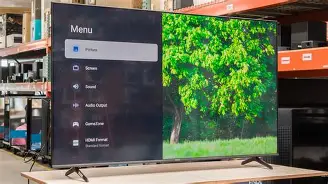
Physically, the U6K is a well-built machine. It features a slim bezel design that gives it a "premium" look, making the screen appear as though it's floating. The stand legs are sturdy and provide enough clearance for most slim soundbars to sit underneath without obstructing the bottom of the screen. For those who prefer to wall-mount, the U6K uses standard VESA mounting patterns. It is worth noting that while the TV is relatively thin, the Mini-LED array and local dimming hardware add a bit more depth and weight to the chassis than a basic edge-lit TV. This contributes to a sense of sturdiness and better heat dissipation.
The remote control included with the U6K is functional and straightforward. It features dedicated buttons for popular streaming services and a built-in microphone for Google Assistant. While it isn't the flashy, solar-powered remote found with some competitors, it is reliable and easy to use in the dark thanks to its intuitive button layout.
Conclusion
Switching to the Hisense U6K is a revelation for anyone who has been "making do" with a standard budget television for the last several years. It represents a paradigm shift in the market, proving that high-end features like Mini-LED and Quantum Dot color don't have to be priced out of reach for most households. While it makes specific compromises—most notably the 60Hz refresh rate and the panel's viewing angles—these are trade-offs that the vast majority of viewers will find acceptable, if they even notice them at all.
What you gain in exchange for those compromises is a vastly superior visual experience. Movies look more cinematic, colors appear more lifelike, and the Google TV interface makes finding something to watch a joy rather than a chore. The U6K isn't trying to be the most powerful TV on the planet; it’s trying to be the best TV for your money. In that regard, it is a resounding success. If you are looking to upgrade your living room without draining your savings, the U6K provides a level of performance that feels like it belongs in a much higher price bracket. It is a testament to how far display technology has come and a reminder that "mid-range" no longer means "mediocre."