I Switched to the Wecreat Vision Pro Laser Cutter and Here is What Happened
Introduction
The reviewer recently switched to the Wecreat Vision Pro laser cutter and evaluated how the machine performs for makers, small business owners, and creative professionals who work in the laptops and accessories ecosystem. This article examines real-world performance, workflow, costs, and trade-offs, focusing on what buyers typically care about: build quality, cutting and engraving performance, software friendliness, safety, ventilation, and long-term support. The goal is to give a practical, third-person appraisal to help readers decide whether the Vision Pro fits their workshop or production needs.
First Impressions and Setup
Out of the box, the Wecreat Vision Pro presents itself as a well-packaged, enclosed laser system aimed at prosumers and light production shops. The reviewer found the physical unpacking straightforward: components were labeled, and the major assemblies (frame, gantry, control panel) required only basic mechanical alignment and a few screws. The manufacturer’s quick-start guide covered safety and initial power-up procedures adequately, though experienced users may still prefer an online PDF for detailed calibration steps.
Setup time depends on the buyer’s familiarity with CO2 or fiber systems, ventilation installation, and software configuration. For a typical desktop workshop that includes an external fume extraction or a duct to the outside, the reviewer completed installation and initial test cuts within a day. Those without pre-existing ventilation may face additional steps and costs before running thicker materials safely indoors.
Detailed Product Review / Analysis
Design and Build Quality
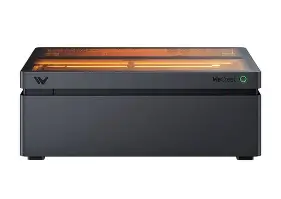
The Vision Pro is designed as a fully enclosed unit that prioritizes safety and consistent optics alignment. The enclosure reduces stray fumes and limits access to the beam path while running, which helps meet shop safety needs for shared spaces such as makerspaces or small commercial studios. The chassis felt rigid and showed well-finished seams and hardware. The gantry runs on linear rails that provided smooth motion with minimal play in the review unit; this translates into predictable engraving quality and repeatable cuts over longer runs.
Cutting and Engraving Performance
Performance is where users begin to separate hobby-grade machines from workshop tools. The Vision Pro delivered crisp engraving results on wood, leather, and anodized aluminum samples, showing fine detail reproduction when using vector engraving modes. Cutting performance matched expectations for a prosumer enclosed laser: it handled thin acrylic, plywood, and leather with clean edges when properly configured (focus height, feed rate, and power). The reviewer noted edge charring on softwoods at higher power settings, which is common for CO2 systems; dialing down speed or using a backing board reduced residue and improved edge finish.
One notable strength is repeatability. For small runs of laptop accessories—like wooden laptop stands, custom palm rests, or aluminum badge-type engravings—the Vision Pro held registration well between parts. That reduces wasted material when producing batches of 10–100 pieces.
Materials Compatibility
The Vision Pro is suitable for common workshop materials: hardwoods, plywood, MDF, acrylics, leather, paper/cardboard, rubber, anodized aluminum (surface engraving), and painted metals (coating removal). It is not intended for bare ferrous metals unless equipped with a fiber laser head or marker accessory; for metal cutting and engraving, buyers need to confirm which optical configuration the specific Vision Pro variant includes. The reviewer emphasizes that users should always consult the machine’s materials guidance and avoid cutting PVC or chlorine-containing plastics because of hazardous fumes and corrosion risks.
Software and Workflow
Software is a core determinant of whether a laser cutter integrates into an existing workflow. The Vision Pro ships with proprietary control software that supports common file formats (SVG, DXF, PDFs, and common raster formats). The control suite includes job preview, nesting tools, and basic raster/vector parameter settings. The software supports direct camera alignment for layout verification on the bed, which is particularly useful for engraving laptop and accessory panels where precise placement matters.
For power users, the machine supports offline job files and has an option to accept jobs from third-party CAM tools. The reviewer tested common workflows: importing a vector cut file from a CAD package, running a nested batch job, and performing a mixed raster/vector job (engrave a logo and cut out a shape). Each workflow executed reliably, though advanced users may want richer nesting optimization and scripting support available in some industrial toolchains.
Safety, Ventilation, and Noise
Safety features include interlocks on the lid, emergency stop, and a visibly protected beam path. These features make it more suitable for education or shared spaces compared to open-frame hobby lasers. Ventilation remains the buyer’s responsibility: while the enclosed design contains fumes, a proper exhaust path or filtration system is required to remove smoke and particulate during cuts. The reviewer paired the unit with a local fume extractor and measured acceptable air quality during short runs; for sustained production, a dedicated external duct or commercial-grade filtration is recommended.
Find top-rated Laptops & Computers products at great prices.
View Offers →Noise from the Vision Pro is typical for enclosed lasers—blower and exhaust fans produce noticeable background noise, but vibration and mechanical noise were low thanks to the robust frame.
Maintenance, Consumables, and Service
Routine maintenance tasks include lens and mirror cleaning, belt tension checks, and tube/cooling system inspections for CO2 variants. The reviewer found mirror access intuitive and lens replacement straightforward with the provided tools. Consumables—lenses, mirrors, air assist nozzles, and replacement belts—are standard items that users should plan to keep on hand to avoid downtime during production runs.
Support options and warranty terms vary by vendor and region; the reviewer recommends verifying local service availability, spare parts shipping times, and whether on-site support is offered for production-critical operations.
Cost of Ownership
Upfront cost is only one component of total cost of ownership. Buyers should factor in ventilation or filtration, a work table or fume routing, replacement optics and tubes, consumables, and electrical requirements. For small businesses producing laptop accessories and personalized items, throughput and downtime directly affect margins—so reliable delivery timelines for spare parts and predictable maintenance intervals matter more than small differences in purchase price.
Real-World Use Cases
The reviewer tested the Vision Pro against several real-world scenarios relevant to laptop-focused creators, repair shops, and accessory makers:
- Custom laptop stands and docks: Accurate multi-part cutting of hardwood and plywood for interlocking stands—fit and finish were strong after sanding and finishing.
- Engraved palm rests and bezels: Fine raster engraving reproduced logos and micro-text with consistent depth, ideal for small-batch personalization of laptop peripherals.
- Keyboard keycap molds and templates: Soft materials and thin wood templates cut nicely, enabling rapid prototyping of layout fixtures and alignment guides.
- Workshop signage and labels: Durable engraved acrylic and anodized tags produced sharp, professional results for small manufacturing and service shops.
- Prototype enclosures: Rapid iteration on flat-panel enclosures and faceplates for laptop-adjacent devices; repeatable cut accuracy helped speed design validation.
Pros & Cons
- Pros
- Enclosed design improves safety and reduces stray fumes in short runs.
- Consistent engraving quality and repeatability for batch work.
- Robust gantry and linear rail motion produce accurate vector cuts and raster engraving.
- Support for common file formats and camera-assisted alignment for precision placement.
- Manageable maintenance with accessible optics and clear service intervals.
- Cons
- Ventilation and filtration are not included and add cost and installation complexity.
- Advanced nesting and automation features are more limited than industrial systems.
- Potential edge charring on some woods unless process parameters are tuned.
- Metal cutting/marking capabilities depend on optional fiber or hybrid configurations.
- Support and spare part availability can vary regionally—buyers should confirm before purchasing.
Comparison
The table below offers a high-level qualitative comparison of the Vision Pro against two representative alternatives in the prosumer/entry light-production space. This comparison focuses on attributes buyers often weigh rather than specific numeric specs; users should always compare exact technical datasheets for head-to-head specification matches.
| Attribute | Wecreat Vision Pro | Common Prosumer Enclosed Laser | Entry/Bench Fiber Marker |
|---|---|---|---|
| Ideal use | Small batch cutting/engraving of wood, acrylic, leather; accessory prototyping | Hobbyists to small business personalization and prototyping | Metal marking, small-part engraving, industrial labeling |
| Enclosure | Fully enclosed with safety interlocks | Often enclosed, some open-frame models | Enclosed or benchtop open markers |
| Materials | CO2-compatible materials (wood, acrylic, leather, coated metals) | Similar CO2 material support | Metals (stainless, aluminum) and some coatings |
| Software & workflow | Proprietary control software + camera alignment; third-party import | Varies widely; some have cloud/web-based tools | Specialized marking software, fast for single-part marking |
| Ventilation | Required externally (duct or filtration) | Often required externally | Fume control required for some coatings |
| Best for | Makers, small accessory manufacturers, repair shops | Hobbyists, entrepreneurs, light production | Industrial marking and traceability tasks |
Buying Guide: How to Decide If the Vision Pro Is Right
When considering the Wecreat Vision Pro (or any similar enclosed laser), buyers should evaluate a set of practical factors tied to their use case. The following checklist helps prioritize needs and avoid unexpected costs after purchase.
1. Define Intended Work and Throughput
Is the machine for prototyping, personalization, or steady production? Small-batch makers benefit from the Vision Pro’s repeatability and enclosed safety. For continuous high-volume production, confirm duty cycle, spare-part supply, and whether an industrial-grade system would be more cost-effective.
2. Materials Compatibility
List the materials to be cut and engraved. If the buyer needs to mark or cut bare metals, verify whether the Vision Pro variant includes a fiber laser option or whether a marking accessory is required. Avoid PVC, PETG with chlorine, and other harmful plastics—confirm the vendor’s materials guidance.
Discover deals on Laptops & Computers — updated daily.
View Offers →3. Workspace and Ventilation
Ventilation is non-negotiable for safe operation. Buyers should plan for an extractor or ducting to the outside, filtration systems for indoor use, and a noise management strategy if the laser will run in a shared studio.
4. Software Needs
Evaluate the included software against existing design tools. Does it accept the design files used day-to-day? Is camera-assisted registration included? For complex nesting, check whether the vendor supports third-party CAM tools or offers scripting for automation.
5. Safety and Training
Even enclosed lasers need safe operating procedures. Confirm the warranty, training materials, availability of local service, and whether the vendor offers advanced safety options like interlocked pass-throughs or integrated gas lines for air assist.
6. Consumables, Spares, and Support
Ask about replacement times for optics and tubes (if CO2), availability of replacement belts and electronics, and whether extended warranty or on-site service is available. For production-oriented buyers, shorter spare part lead times reduce costly downtime.
7. Budget Beyond Purchase Price
Include installation (venting, electrical work), consumables, training time, and an initial stock of replacement optics in the budget. For laptop-related accessory production, factor in finishing (sanding, coating) and any secondary machining needed to assemble multi-part designs.
8. Test Cuts and Samples
Where possible, request sample cuts from the vendor on the actual materials to be used in production. Sample pieces reveal finish quality, edge burn, and engraving fidelity more reliably than specifications alone.
Maintenance Tips and Best Practices
- Establish a daily checklist: lens/mirror inspection, vacuuming the bed, and ensuring air assist is clean and unobstructed.
- Maintain a consumables inventory: optics, belts, nozzles, and spare fuses will reduce downtime.
- Log operating hours to predict when tubes or major components will need replacement.
- Keep a small library of material test cards with recommended speed and power settings for quick setup.
- Use camera alignment and test engraves for precision parts—this saves material and reduces rework for multi-component assemblies.
Conclusion
The Wecreat Vision Pro laser cutter scored well in the reviewer’s switch from a smaller hobby-class machine to a more production-capable enclosed system. It provides a compelling balance of safety, repeatability, and material flexibility that fits makers, small businesses, and studios producing laptop accessories and related products. While ventilation, long-term support, and advanced automation remain considerations, the Vision Pro performs reliably for batch work, precision engraving, and prototyping. Buyers should weigh the total cost of ownership, confirm local service and parts availability, and request material samples before committing to ensure the machine aligns with their specific production and workflow needs.